Next to research, I also believe that teaching is an invaluable part of academia and that one’s own research can contribute immensely to teaching and vice versa. With this in mind, I developed a serious of courses that each follow a specific didactic focus – from introductory, to rethinking the curriculum, cutting-edge research, methods training or research-process orientation. Thereby, my teaching aims to nudge students to challenge conventional disciplinary boundaries and facilitate interdisciplinary thinking.
_____
Introduction to International Political Economy
This introductory undergraduate course introduces the sub-discipline of International Political Economy (IPE). The field of IPE does not have a clear, universally agreed set of concerns, assumptions, or theoretical underpinnings but has rather been characterised as a ‘field of inquiry’, ‘set of questions’ or ‘area of investigation’ exploring the inter-relationships between politics and the economy in an international context. How does the global (political) economy work, and for whose benefit? The course examines empirical developments and challenges in IPE, contemporary issues related to: global trade, production, multinational corporations, consumption, finance, economic crises, development, digitisation, climate change and national/global capitalism(s). Whether it be the US-China trade war, the costs and profits from climate change, or the instability of global financial markets, this course aims to develop an ability to analyse, compare and critically evaluate fundamental assumptions and arguments about the ways in which political and economic spheres are globally connected.
You can check out the syllabus here.
_____
China and the Global Economy
This advanced undergraduate course analyses China’s changing role in the contemporary global political economy. China has become central for how global capitalism functions. The aim of this course is to critically analyse China’s rise and impact on the global economic system. In part 1, the course provides an overview of China’s socio-economic system, its economic transformation (reform and opening) as well as the characteristics and development of Chinese capitalism. In part 2, the seminar explores in detail China’s integration into and changing role within the global economy. Thereby, China is placed into the center of the analysis of the global economic system, investigating China’s changing role in areas such as global finance, trade, production, consumption or digitisation.
From global value chains, China’s role as factory of the world, the advent and decline of the Chimerica-constellation, China’s rise in development finance, the US-China trade war to reshaping global infrastructure and trade flows through the Belt and Road Initiative, the course aims to develop an ability to analyse, compare and critically evaluate fundamental assumptions and arguments about the ways in which the global economy functions. Thereby, the course moves away from a purely Eurocentric perspective on the global economy by building on both ‘Western’ and Chinese scholarship and perspectives, enabling students to gain a more nuanced understanding of China’s changing global role and its implications. Basic knowledge in IPE is essential for this course.
You can check out the syllabus here.
_____
Politics of Global Finance
This postgraduate course analyses the (changing) politics of global finance. The global financial system, its governance and how it conveys power in the global political economy have been important research topics in International Political Economy (IPE). However, since the global financial crisis (2007-2009), the global financial system has been subject to multiple shifts that require closer analysis. How has the role of central banks changed through quantitative easing? Are stock exchanges really just marketplaces? Does finance function differently in non-Western countries? Are banks still the masters of the universe?
Addressing these and other questions, the course examines empirical developments and conceptual innovations in the politics of global finance since the global financial crisis. The course first discusses the historical development of the global financial system and introduces theoretical concepts for its study such as structural power, private authority, financial hierarchies or market infrastructures. Second, the course analyses shifts in global finance such as the emergence of important financial actors, changing practices in global markets, their interlinkages and post-crisis implications, including (but not limited to): the transformation of banks, the rise of non-bank actors investors, the growing importance of emerging markets, the shift towards passive investing or the advent of high-frequency trading. Through an exploration of these topics, the course aims to address central IPE questions about the politics of global finance: Who holds power in global financial markets? How is this power exercised? Are the loci of power shifting? And who benefits from this setup?
You can check out the syllabus here.
_____
Research Design in International Political Economy
This postgraduate course focuses on applied research methods. How do scholars conduct research in International Political Economy (IPE)? Whether it is assessing the effects of the US-China trade war, explaining the lobbying success of global financial actors, uncovering corporate ownership networks or investigating how austerity became the dominant ideology that influenced the management of the eurozone crisis, how we design our research is crucial.
This course aims to assist students with making choices in setting up and conducting their own research projects, covering a range of topics: starting from the formulation of research topics and research questions, application of theories, concept specification and operationalisation, the design of data collection activities, and basic qualitative and quantitative data analysis techniques. Instead of focusing on a specific method, the course addresses a variety of approaches to empirical research in IPE such as network analysis, inferential and descriptive statistics, archival research, expert interviews, case studies or participant observation. During the course of the seminar, students are expected to use these insights to design, present and conduct their own research projects in the area of International Political Economy. The course is designed as preparation for an MA thesis in the field of IPE.
You can check out the syllabus here.
_____
Qualitative Methods
How do scientists conduct research? How do we ask questions to which we seek answers? And how do we go about answering them? These and similar questions are crucial when designing research projects, and students are confronted with these questions throughout their studies (and especially when writing a dissertation). This seminar introduces the principles and practice of qualitative research. The main aim of the course is to develop an understanding of what issues can be investigated through qualitative research and the characteristics of successful qualitative research designs.
Best practices in qualitative research will be taught through examples of application to enable participants to critically examine qualitative research, evaluate its methodological quality and develop their own qualitative research designs. The course does not focus on one particular method, but covers a variety of approaches to empirical research such as document analysis, descriptive statistics, interviews, or ethnographic methods.
You can check out the syllabus here.
_____
Geopolitics in the 21st century: States, markets and power in a fractured world
This block seminar focuses on recent empirical and theoretical developments at the intersection of International Security and International Political Economy. In less than a decade, world politics has radically changed. Since the Trump presidency, geopolitical tensions – especially between China and the US – have fundamentally called into question the (neo)liberal compromise between states and markets. Arguably, existing distinctions between the subdisciplines of International Political Economy and International Security/Relations no longer hold. On the one hand, markets have become subject to increasing state intervention – and have even become increasingly weaponized – in the face of rising geopolitical tensions. From sanctions to investment screening mechanisms and export controls, companies are suddenly faced with severe political constraints to their business operations. On the other hand, market actors have complicated and even undermined the geopolitical strategies of states. Despite political decoupling, US and European companies have for instance intensified their business activities in China in recent years and sanctions against Russia have arguably been rather ineffective.
How does a new cold war within global capitalism look like? Who holds power within this increasingly fractured world, how is it distributed and what is its source? How has the relationship between states and markets changed? Drawing on Susan Strange’s theory of structural power, this course explores the reconfigured relationship between states and markets within a world that is seemingly moving away from the neoliberal equilibrium and increasingly fractured by geopolitical tensions. The course explores four aspects of structural power – finance, production, knowledge and security – and their contemporary global reconfigurations across different geographies.
You can check out the syllabus here.
_____
Frankfurt: Exploring a Financial Center
The Rhine-Main region is significantly shaped by the Frankfurt financial center. There are few places where the political influence and economic power of the financial sector is as visible and tangible as in Frankfurt’s banking district. But what role exactly does the financial centre of Frankfurt play in the global financial market architecture? Which players and institutions (inter)act here? Which products and services circulate? What rules and laws apply? Which infrastructures exist? What can be learnt in Frankfurt about the history of the financial sector, about scandals, crimes and political resistance? And finally, what new insights and perspectives does Frankfurt as a research site offer about the role of the financial sector in capitalist democracies and in the global political economy?
Following a research-based learning approach, this undergraduate course addresses these and other questions through student-led research projects. Students will acquire basic knowledge about financial markets and receive an introduction to political science approaches for researching them, which they then apply in projects supervised by the lecturers. The seminar is organised in cooperation between Goethe University Frankfurt and Johannes Gutenberg-University Mainz. The results of the research projects will be presented at a joint final conference at JGU Mainz and will ultimately be published on as a series of blog entries.
Here is the link to the website (under construction).
_____
Applied Research Methods: The Geoeconomics of US-China Competition
The intensifying geoeconomic competition between the United States and China represents one of the most significant transformations in the contemporary global political economy. The US and China now compete on a global scale for centrality in interdependent economic networks that underpin 21st-century hegemony. Strategic economic tools—such as export controls, infrastructure investment, and industrial policy—are increasingly wielded in pursuit of geopolitical aims. This rivalry is not only reshaping trade flows, technological development, and investment patterns—it is also calling into question the (neo)liberal compromise between states and markets that has defined the post-Cold War global order. As such, the study of US-China geoeconomic competition offers a vital entry point for understanding contemporary power dynamics, making it a central concern for scholars of International Political Economy.
But how to best conduct research on the geoeconomics of US-China competition? How are research questions formulated, and how do we develop appropriate strategies for answering them? These questions are central to any academic inquiry and will arise repeatedly during students’ studies—especially in the context of independent research projects and dissertations. Whether exploring the impact of trade tensions, mapping technological decoupling, tracing infrastructure dependencies, or analyzing the influence of global firms in restructured supply chains, the quality of our research design is foundational to the insights we produce.
You can check out the syllabus here.
_____
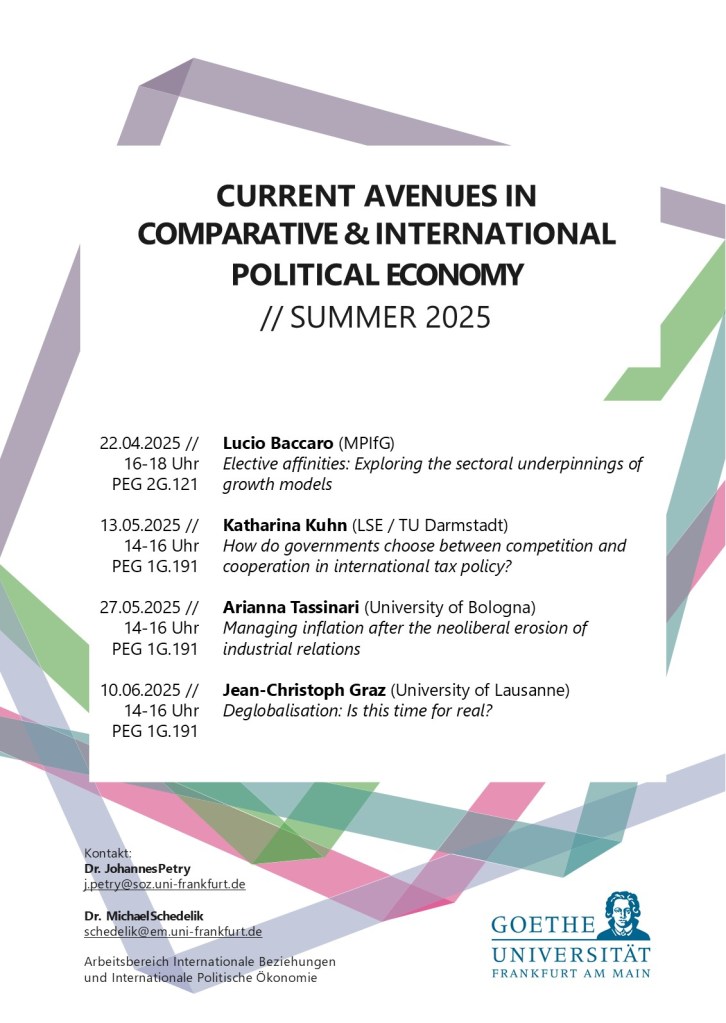
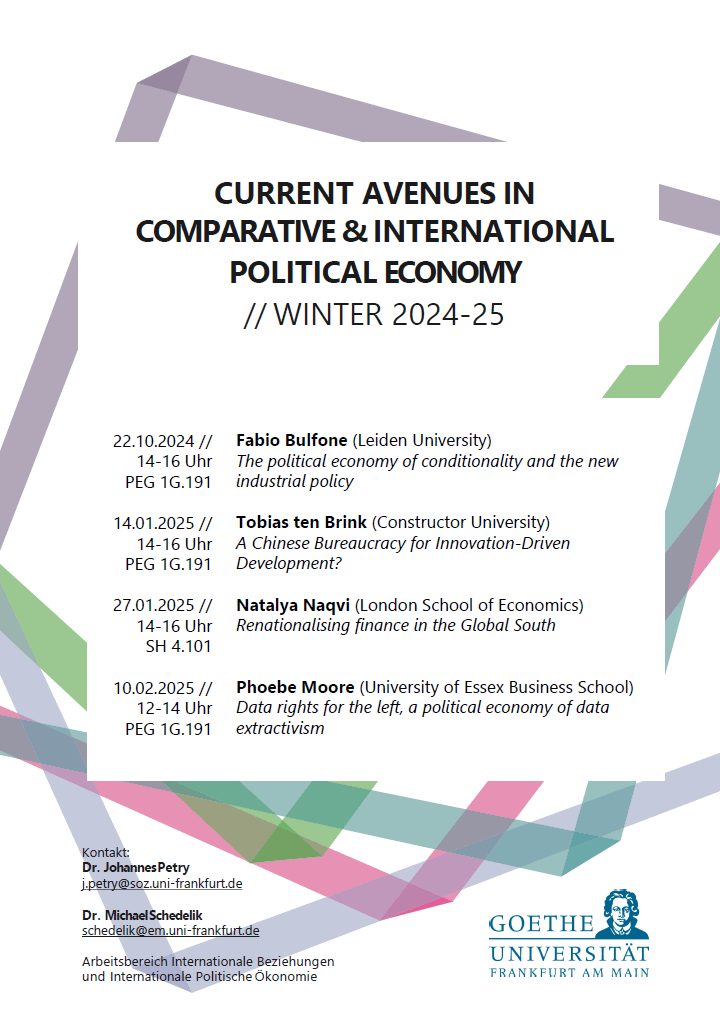
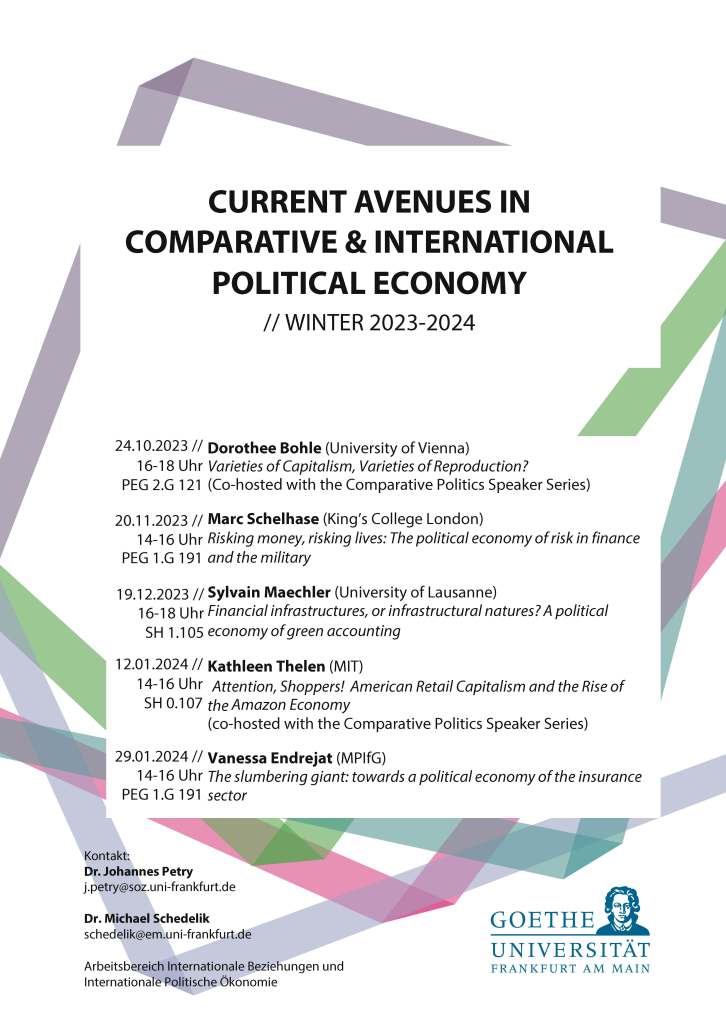
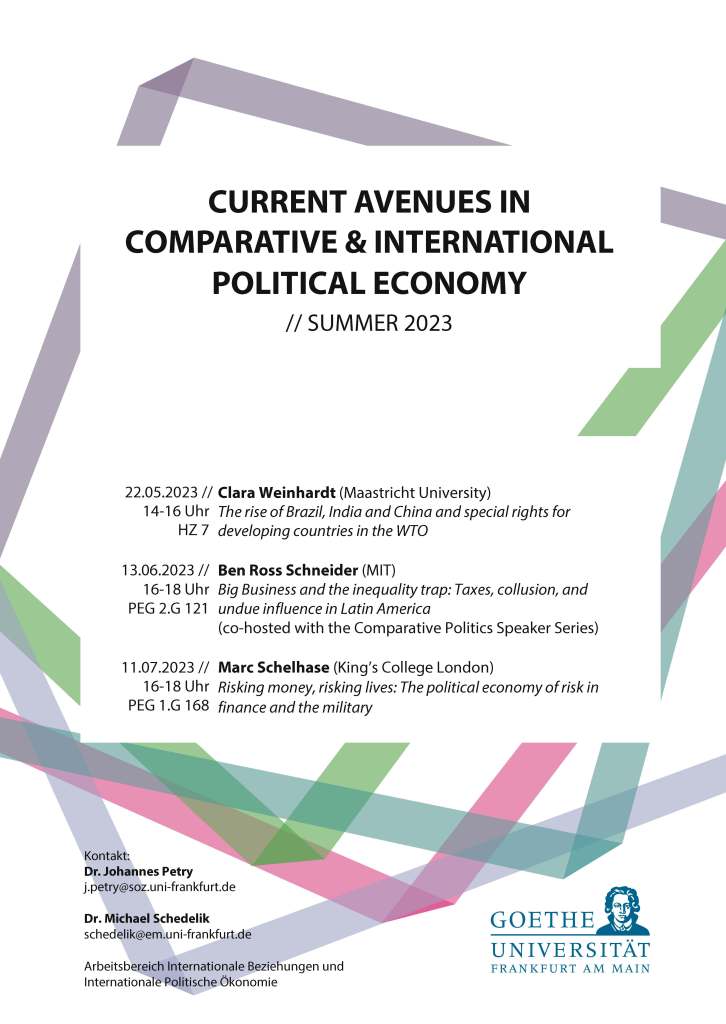
Current Avenues in Comparative & International Political Economy Lecture Series
In this lecture series we invite leading scholars from Comparative and International Political Economy to present their ongoing research projects that engage in cutting-edge discussions in the discipline both in terms of the concepts they use and develop as well as with respect to their empirical work. What is the spectre of state capitalism and how should we think about the role of the state in the 21st century global economy? How to analyse regulatory cycles in finance and the role of central banks as crucial actors during times of financial turbulence? How does infrastructure finance determine the geo-economics of the Indo-Pacific amidst a politics of global economic decoupling? The lecture series aims to explore these and other questions by bringing leading scholars into conversation with the growing Comparative and International Political Economy crowd at Goethe University and the greater the Frankfurt area.
Here is the line-up for the last semesters:




_____
Supervision
I supervise BA and MA dissertations in the following subject areas: International Political Economy, Comparative Political Economy, Development Studies, Social Studies of Finance, China Studies, Financial Geography, Economic Sociology
Examples of recently/currently supervised topics:
- An intersectional critique of critical macro-finance
- Green energy transition in South Africa
- The rise of the Open Economic Politics paradigm
- ESG and the German banking industry
- Feminist perspectives on Alternative food networks
- State capitalism and capital markets in Turkey
- Economic sanctions and protectionism
- Money and democracy
- Empire, 20 years on
 Johannes Petry